
Ventilation-Perfusion Ratio
Listen to the Lesson Topic
Playing the audio in full is required to complete this topic.
During or after listening, read below to review with visuals.
Read Topic with Visuals
Ventilation and perfusion are crucial elements of gas exchange in the lungs, and their matching is essential for efficient respiration. As illustrated by the V/Q ratio shown in Figure 1, ventilation (V) refers to the amount of air that reaches the alveoli, where gas exchange takes place, and perfusion (Q) is the amount of blood that flows through the capillaries surrounding the alveoli. When the V/Q ratio is off such as in cases of poor blood flow such as pulmonary embolism or shock or in cases of inadequate ventilation, gas exchange is impaired.
Figure 1. V/Q Ratio

Efficient gas exchange requires a balance between ventilation (air reaching the alveoli) and perfusion (blood reaching the alveoli via pulmonary capillaries). This relationship is described by the ventilation/perfusion (V/Q) ratio. A V/Q ratio of 1 indicates perfect matching of air and blood flow in an alveolar unit, but in practice, the average V/Q ratio is about 0.8, because the lungs receive approximately 4 liters of air and 5 liters of blood per minute, and a 4 to 5 ratio or 4/5 equals 0.8.
A V/Q mismatch happens when the V/Q ratio is greater or less than 0.8. A V/Q greater than 0.8 indicates ventilation exceeds perfusion. A V/Q less than 0.8 indicates perfusion exceeds ventilation.
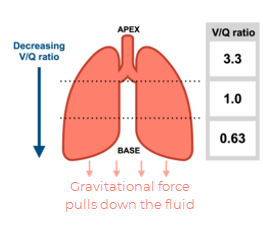
Gravity also plays a role in regional differences. In an upright person, the lower lungs receive more blood flow due to gravity, while ventilation tends to be better at the bases, though less so than perfusion. As illustrated in Figure 2, this results in lower V/Q ratios at the bases and higher V/Q ratios at the apex of the lungs. Lower lungs have a relatively greater amount of blood while the upper lungs have a relatively greater amount of air.
Figure 2. Normal V/Q of 0.8
An example of ventilation to perfusion is illustrated in Figure 3. At a subway station, there are people on the platform. When the subway car arrives, people exit the subway car, and the people on the platform enter the subway car. If there is enough room on each subway car for each person to have one seat, this is a 1 to 1 ratio. The people on the subway platform represent oxygen molecules, and the people on the subway car exiting represent carbon dioxide. That makes the subway car the blood flow. If we have more people on the subway platform and not enough seats on the subway car, there is a ventilation to perfusion ratio greater than 1. This is because we have more oxygen available than we have hemoglobin to transport the oxygen.
Capnography helps EMS providers detect these imbalances. A drop in end-tidal CO₂ (EtCO₂) may indicate impaired perfusion, while elevated or changing values can signal ventilation issues.
Figure 3. Example of V/Q Ratio

Mark the lesson complete before continuing.